How to Stop Revenge Trading Before It Destroys Your Account
By Steve Ira Present, M.S. | Trading Psychology Specialist | Updated April 2026
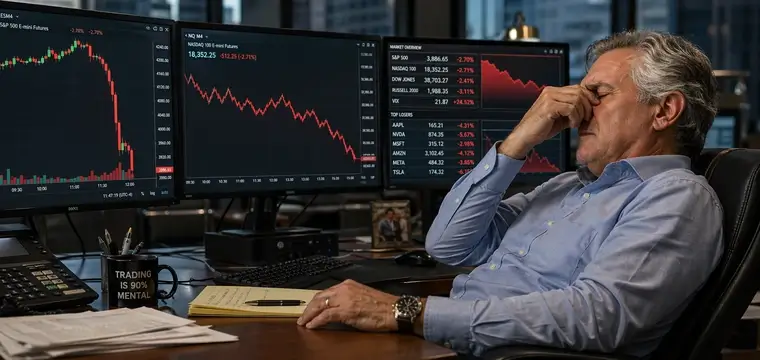
You took a loss. A big one. Or maybe three in a row.
Your method says wait. Your rules say stop. But something far more powerful than your rules takes over — and you go back in. Hard. Fast. With size you should not be using.
That is revenge trading. And if you have done it, you already know how it ends.
What most traders do not know is WHY it happens. Not the surface reason — "I got angry." The real reason. The one that runs so deep that no amount of willpower, screen breaks, or trading journals will touch it.
That is what this article is about.
What Revenge Trading Actually Is — and What It Is Not
Revenge trading is not about being reckless. Most traders who revenge trade are smart people. They know their rules. They have studied their method.
But after a loss — especially a painful one — they act like a completely different person.
That is the clue. When a smart trader does something obviously not smart, consistently, that is not a knowledge problem. That is a subconscious program running the show.
The Difference Between a Bad Trade and a Revenge Trade
A bad trade happens. Every trader has them. You enter, the market moves against you, you exit per your rules. That is trading.
A revenge trade is different. It happens BECAUSE of the previous loss. The anger from that loss is what puts you back in — not your method, not your analysis. The emotion made the decision. Your finger just clicked the button.
Why Angry Traders Take More Risk — Not Less
Here is something that surprises most traders.
You might think anger would make you freeze. It does not.
Anger makes you MOVE. It makes you feel certain. It makes the next trade feel obvious — even when it is not.
That is the trap. The angrier you are after a loss, the more convinced you feel that the next trade will work. Research confirms this. Angry people overestimate their chances of winning. They take bigger risks. They ignore warning signs.
So the emotion that follows a loss — the one that feels like motivation to "fix it" — is the exact emotion that is most dangerous to your account.
Write that down.
What Is Really Causing Revenge Trading — The Root Cause
How many of you, when you lose, feel more than just financial pain?
How many of you feel like you failed? Like you are not good enough? Like you have to PROVE something — to yourself, to your spouse, to anyone watching?
That feeling is not coming from logic. Logic knows you will lose sometimes. Every trader does.
That feeling is coming from a program. A deep one. One that was likely formed long before you ever placed a trade.
As Steve Present puts it: "The revenge trade is never really about the market. It is about what the loss means to the trader at a very deep level. When losing feels like failing as a person, the subconscious fights back. And it fights back with your trading account."
Common root causes behind revenge trading include:
The need to prove yourself. When your self-worth is tied to your trading results, every loss becomes a personal attack. The subconscious demands that you fight back and prove you are a winner.
Losing money feels like losing identity. For many traders — especially men — losing money activates a deeply held program that says "losers lose money." The revenge trade is the subconscious trying to escape that label — fast.
The need to get whole. A hidden program that says you must recover losses before you can feel okay again. This is one of the most common — and most destructive — programs in trading.
None of these programs are your fault. Most of them were formed between birth and age eight. You could not stop them from getting in. But they are your responsibility to address.
Why Discipline Will Not Stop Revenge Trading
Think about a pot of boiling water. The steam is your revenge trading behavior. You hate the steam. So you put a lid on it. The lid is your discipline.
For a while, it works. The steam stops coming out.
But the heat is still on. The pressure builds. And eventually — it explodes.
That is why every trader who has ever white-knuckled their way through discipline eventually cracks. Not because they are weak. Because discipline is the wrong tool for a subconscious problem.
The fix is not the lid. The fix is turning off the heat.
Warning Signs You Are About to Revenge Trade
Your body knows before your mind does. Watch for these:
Your chest gets tight or your heart rate jumps right after a loss. That is your nervous system activating.
You feel an urgent pull to get back in the market immediately. The urge feels rational — it is not. It is emotional.
You start justifying a trade that does not meet your setup criteria. You are not analyzing the market. You are arguing yourself into a revenge trade.
You increase your size after a loss — even slightly. That is the subconscious trying to "make it back faster."
You feel certain the next trade will work. That certainty after a loss is a red flag. It is anger masquerading as conviction.
If any of these sound familiar — this is not a character flaw. It is a subconscious program firing. And it can be addressed at the root.
How to Actually Stop Revenge Trading
Here is what does NOT work long-term:
Taking a walk after a loss. Setting hard stop rules. Posting reminders on your screen. Asking your spouse to hold you accountable. Meditation. Affirmations. More discipline.
None of these address the root. So they all wear off. The subconscious is patient. It waits. Then it takes over again.
Here is what actually works:
Finding the specific subconscious program behind YOUR revenge trading response — and addressing it at the source. Not managing the steam. Turning off the heat.
Every trader's root cause is different. For one trader it is the need to prove himself. For another it is a deep-seated belief that losing equals failure. For another it is a worthiness issue that has nothing to do with trading on the surface.
That is why groups do not work for this. That is why audio programs do not work for this. The root cause is yours. The solution has to match it.
For a deeper look at the subconscious programs behind trading psychology challenges — including revenge trading — see the full guide at tradingpsychologyhelp.com/trading-psychology/.
About Steve Ira Present, M.S.

Steve Ira Present, M.S., has spent 36 years in private practice helping people overcome deeply stubborn challenges — and the past 15 years focused exclusively on traders.
He does not work in groups. He does not sell audio programs. He works one-on-one, because trading psychology challenges are individual. Your root cause is yours. The solution has to match.
His method is designed to locate, identify, and address the specific subconscious programs that produce trading problems like revenge trading, overtrading, fear of pulling the trigger, and account-destroying emotional cycles.
He backs his work with a full money-back guarantee on the first session — based on 15 years of results with serious traders.
Final Thoughts
Revenge trading is not a character flaw. It is not proof you are a bad trader. It is a subconscious program firing — one that connects loss to something far more personal than money.
The good news: programs can be addressed. When the root cause goes, the behavior goes with it.
Not managed. Not suppressed. Gone.
Traders who address the root cause of their revenge trading describe a very specific experience afterward. They take a loss. They feel the market move against them. And they feel... calm. Present. Ready for the next setup.
That is not discipline. That is what trading looks like when the root cause has been addressed.
Ready to Stop the Revenge Trade Cycle?
You know what it is. You know discipline is not the answer. The root cause has to go.
Frequently Asked Questions About Revenge Trading
What is revenge trading?
Revenge trading is taking impulsive, high-risk trades immediately after a loss — caused by anger, frustration, and the need to get money back fast. It is not a strategy. It is an emotional reaction. And it almost always makes losses worse.
Why do smart traders revenge trade?
Because the urge to revenge trade does not come from the conscious mind. It comes from the subconscious — from a program formed long before the trader ever placed a trade. Discipline and willpower cannot overpower it. The root cause has to be addressed directly.
Can a trading psychologist help with revenge trading?
Yes. A trading psychologist who works at the subconscious level — not just symptom control — can identify what is triggering the revenge trade response and work to address it at the source. This is different from talk therapy or standard coaching.
How is revenge trading different from overtrading?
Overtrading is taking too many trades in general — often caused by FOMO, boredom, or the need for action. Revenge trading is specifically triggered by a loss. It is the emotional backlash after getting hurt. Both are symptoms of subconscious programs — but different programs with different root causes.
What triggers revenge trading?
A loss triggers it. But the real trigger is deeper — it is what that loss means to the trader at the subconscious level. For most traders, a loss feels like proof of failure, weakness, or unworthiness. The subconscious then fights back hard. That fight is what shows up as a revenge trade.
References
Lerner, J.S., & Keltner, D. (2001). Fear, anger, and risk. Journal of Personality and Social Psychology, 81(1), 146–159. Angry people make optimistic risk assessments and seek out riskier choices — directly relevant to why traders revenge trade after a loss.
Leith, K.P., & Baumeister, R.F. (1996). Why do bad moods increase self-defeating behavior? Emotion, risk taking, and self-regulation. Journal of Personality and Social Psychology, 71(6), 1250–1267. Negative emotional states actively undermine self-regulation and increase risk-taking and self-defeating decisions.
Kahneman, D., & Tversky, A. (1979). Prospect theory: An analysis of decision under risk. Econometrica, 47(2), 263–292. Losses feel roughly twice as painful as equivalent gains feel good — which explains the intensity of the emotional response that produces revenge trading.
Van den Bos, R., Harteveld, M., & Stoop, H. (2009). Stress and decision-making in humans: Performance is related to cortisol reactivity, albeit differently in men and women. Psychoneuroendocrinology, 34(10), 1449–1458. Stress hormones directly impair decision-making before conscious awareness can intervene.
Fenton-O'Creevy, M., Soane, E., Nicholson, N., & Willman, P. (2011). Thinking, feeling and deciding: The influence of emotions on the decision making and performance of traders. Journal of Organizational Behavior, 32(8), 1044–1061. Emotions and their regulation play a central role in every trading decision. High performers manage emotions differently from low performers.


